What Does Spirituality Mean To You?
Luminous beings are we...not this crude matter.

Hello hello,
Happy Springtime to all of you! I hope this newsletter finds your flowers blooming and your allergies manageable.
Below, as always, you can find the events we have coming up in our BreadBreakers community, as well as some “Food for Thought” for your perusal.
One particularly exciting new thing that I’m looking forward to is Soul Coffee, an informal gathering where you can get some caffeine to start your day and some conversation to feed your soul. See below for details, and take a look at the”Food for Thought” for some thoughts on why a cuppa soul might be just what you need.
Upcoming BreadBreakers Events
Soul Coffee (No RSVP required, but if you’re able to sign-up here, it helps us make sure we claim enough chairs!)
When: Sunday, April 12th, 8:00-9:45am
Where: Simply Social Coffee, Reston Location (11511 Sunrise Valley Dr, Reston, VA 20191)
What: An informal gathering where we can connect a bit deeper, check in on each other, and share some real soul conversation together - as always, across beliefs and traditions.
Cost: No cost other than the coffee you buy :)
April BreadBreakers Community Dinner (Sign-up here or on Meetup.com)
When: Wednesday, April 22nd, 6:30-8:30 pm
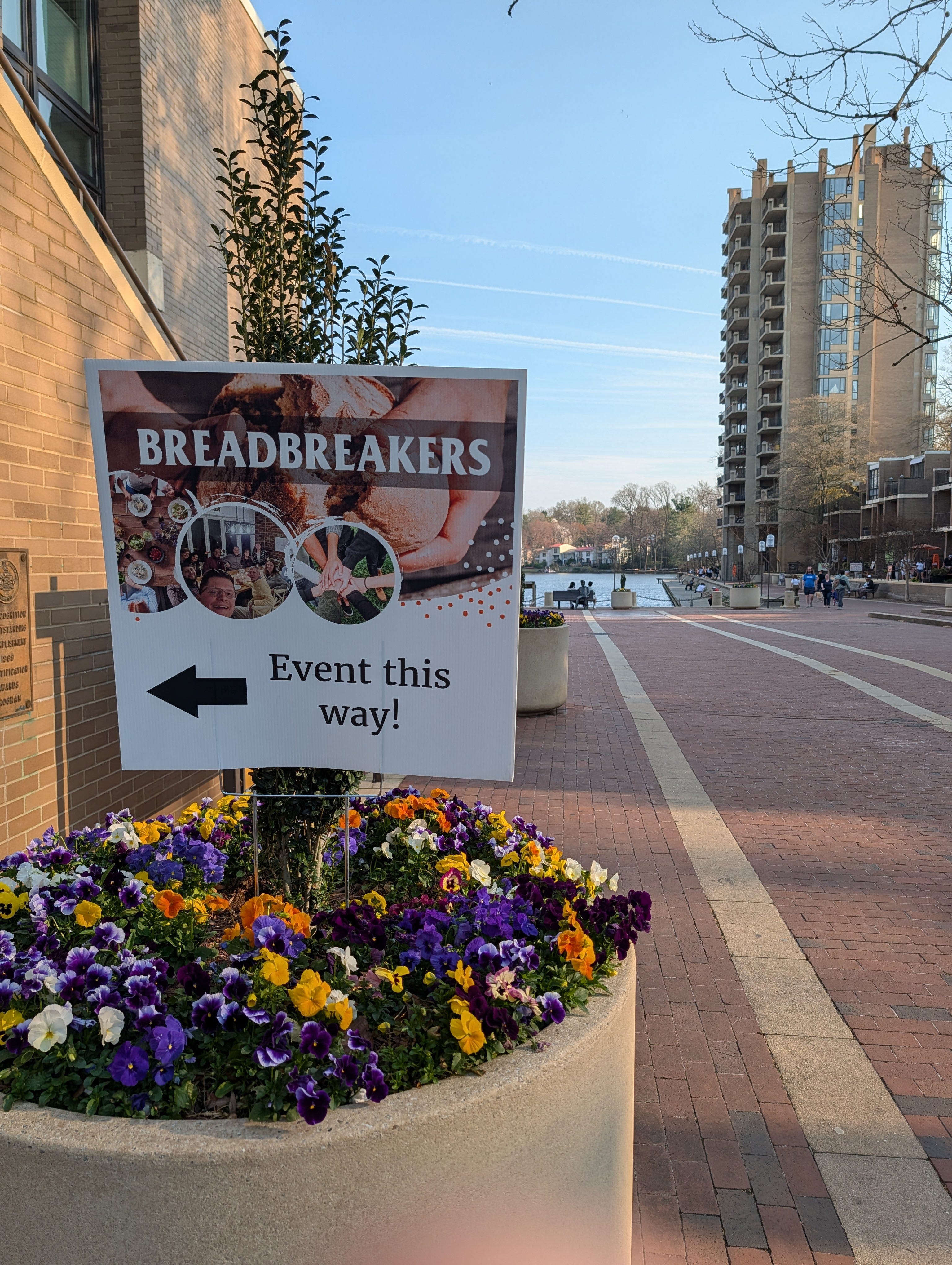
Where: Reston Community Center - Lake Anne (1609-A Washington Plaza N, Reston, VA 20190)
What: Our main monthly gathering with multiple tables breaking bread at the same time. Three different topics to choose from, ranging from current events, to spiritual or philosophical questions, to different parts of the human experience. Whether you’re looking for good discourse or simply to connect with others in a meaningful way, there’s a table for you.
Cost: Dinner is provided for free, but at-will donations are accepted if you’d like to contribute toward BreadBreakers’ costs.
Save The Date: Future BreadBreakers Community Dinners on May 28th, June 24th, and July 30th
Food for Thought - What Does Spirituality Mean To You?
“Luminous beings are we...not this crude matter. You must feel the Force around you.”
- Yoda, Jedi Master
Two dinners ago, several of our tables took up the question, “What does spirituality mean to you?” I was sad not to be able to join the discussions, but I’m told they were some of our most connective and depthful conversations to-date. That they were beautiful exchanges of perspectives that ranged across beliefs (religious and not) but all spoke to the same common truth:
We, human beings, are spiritual creatures.
We need connection to something both wider and deeper than ourselves - something greater, but also utterly personal.
It was this sentiment that was shared, too, by several BreadBreakers volunteers from a variety of spiritual backgrounds when, in preparing for this newsletter, I asked them to contribute some of their own reflections on spirituality. (Make sure you continue to the bottom to read their reflections in their entirety, by the way - it’s seriously worth your time.)
Alicia, one of our table hosts, wrote, “Spirituality is believing that there’s something greater. It’s about feeling connection to others, feeling purpose and experiencing awe. Spirituality inspires positive feelings of joy, contentment, and peace.”
Another host, Todd, wrote, “A person’s spirituality is their belief about ‘what is and why’, which gives their life a meaning. This meaning gives them a purpose.”
Meaning and purpose. We need to understand how our own selves fit into the bigger picture; what that means for our lives and for how we relate to others. When we don’t have that sense - or when we thought we had it but lose it - we feel anxious. Unmoored. Disconnected. Maybe even helpless; useless; alone.
And, as tends to happen, the effects of what’s going on inside tend to not stay inside. They feed into the way we approach others; our pursuits, our work, our friends and family, our conversations, our disagreements.
In one way or another, our deepest social ills today - mass loneliness, rampant hopelessness, our infected discourse - all run back to that hole in our souls, that discontent, that drive to find and then defend at all costs our innate senses of who we are in the world. Either we haven’t found it and we’re desperately looking, or we’ve found it in a place that draws artificial lines between “us” and “them”, or we’ve found it in something that won’t last - and we know it.
And yet, in much of life today, we seem to have collectively decided that the spiritual isn’t something we’re supposed to talk about with each other.
We’ve equated it with religion (save it for your pastor, or your rabbi, or your spiritual advisor); with the supernatural (let’s keep it rational, man!); with the squishy and uncomfortable (oh gosh, are you going to make me sing with you?). We button up, put our professional faces on, and leave the spiritual stuff for those few minutes of existential dread when we’re trying to fall asleep.
This is why, in BreadBreakers, we include the spiritual stuff in our topic lists. And it’s why we’re starting up Soul Coffee, a place to talk about how our souls are doing, how we’ve experienced wonder lately, and what we’re truly needing right now. (Check it out on the 12th; details above; no RSVP required, though if you sign up it’ll help us ensure enough chairs.) Because if spirituality is that intrinsic to our lives, how could it not be that intrinsic to a community where we’re supposed to be our full and true selves?
In fact, I think spirituality even goes a bit deeper than that in BreadBreakers - it permeates even our conversations and interactions that aren’t explicitly “spiritual.”
Because when we come to BreadBreakers, we come seeking something good and whole, to connect in some way to that great good. We seek it knowing that if we don’t pursue the good, the world or our own selves will fill the hole with something not-good. As C.S. Lewis once wrote, “Spiritual nature, like bodily nature, will be served; deny it food and it will gobble poison.”
We know there’s a better way of be-ing in the world than the fragmentation and invective we see around us - a way rooted in compassion, care, humanity, connection.
And the beautiful thing is that the ultimate Good at the center of it all will look a little different for each of us, but they all point toward the same wholeness.
For me, that capital-G Good is Jesus, the man who, in my faith tradition, both embodied perfect compassion and told me that my identity is that of a beloved son of God, freed of the need to prove my worth, to let my soul be at rest.
For you, it might be the same God, different scriptures; it might be Brahman; it might be Nirvana; it might be the beauty of billions of human beings coming together in their mutual empathy to create community, morals, and shared meaning.
No matter who or what it is, BreadBreakers points us in that direction, and when we head in that direction we find ourselves in more harmonious relationship with one another.
Pete Wehner recently wrote about the meaning of shalom, a word found in my Christian tradition but found before that in the Jewish tradition. Most translate the word to “peace”, but as Wehner writes, “...Its fuller meaning is something closer to human flourishing...Rabbi Jonathan Sacks characterized it as a ‘state in which everything is in its proper place and all is at one with the physical and ethical laws governing the universe.’”
Alignment, rightness, wholeness, with the ultimate Good and with each other - the very thing another of our table hosts, Albert, wrote of when he referred to spirituality as a “disciplined effort to align one’s character with reason, humility, and the natural order of things.” That Todd from earlier pointed to when he wrote of spirituality in his life, “Believing that we are all connected and that there are truths independent of belief, I seek to find and understand those truths so I can live in accordance with them.”
And the best news of all - we can travel in that direction together, knowing we won’t ever fully get there (not in this lifetime anyway), but that there’s goodness in the traveling. In both BreadBreakers and in Spirituality, we find that imperfection is baked in. As yet another table host wrote of their spiritual journey:
“I feel freer now—no longer needing to be on my ‘A game’ at all times. It’s okay to make mistakes, to fall short, and to trust that growth continues. Spirituality is helping me accept where I am in life and reminding me that meaningful relationships and everyday beauty matter far more than perfection. Wow!”
Wow, indeed.
So wherever you are in life; whatever spirituality means to you; whatever your Good is - let’s acknowledge it. Let’s talk about it. And let’s travel toward it together.
And don’t forget to check out the full versions of what our volunteers wrote! Their reflections are just below my signature.
All the best,
Michael Graham
(P.S. To see every past issue of BreadBreaking News in one place, head over to our Substack page.)
(P.P.S. Know someone who’d like to be on this email list? They can sign-up here!)
(P.P.P.S. If you wanna connect on Facebook, you can follow the BreadBreakers page and/or my page at these links!)
Reflections From Some Volunteers - What Does Spirituality Mean To You?
Alicia, Table Host and Dining Room Team Member:
Spirituality is not about religion or going to a place of worship or even about believing in God.
Spirituality is believing that there’s something greater. It’s about feeling connection to others, feeling purpose and experiencing awe. Spirituality inspires positive feelings of joy, contentment and peace.
For some, spirituality helps bridge the gap between religious beliefs and scientific facts in order to be comfortable with the unexplainable.
Spirituality takes in the outside world but comes from within.
My table included people with a mixture of religious views, including Jewish, Christian, Muslim, agnostic, and atheist. Each had a personal perspective to share, however no views were in opposition to the communal view on Spirituality. I think that speaks to the notion that spirituality transcends all religions and exists in each of us, no matter our religious beliefs.
Albert, Table Host:
For someone who has migrated from being a devout Catholic to becoming an equally devout agnostic, it is not easy to evaluate the notion of spirituality. The term itself lost much of its meaning during my challenging journey toward agnosticism.
The word seems to have undergone a transformation similar to my own path: from its Biblical sense—being animated by the spirit of God—to a far more diffuse meaning that gradually emerged toward the end of the Middle Ages, and eventually to the modern usage that became increasingly detached from formal religion during the late twentieth century with the rise of secularism.
In this newer sense, secular spirituality no longer refers necessarily to a relationship with the divine, but rather to a search for meaning, depth, and inner orientation in life. Yet for someone who once experienced spirituality within a clear theological framework, this broader definition can feel both liberating and elusive: liberating because it allows room for intellectual honesty; elusive because the certainty that once anchored the concept has faded.
Some philosophical traditions have helped me reinterpret the idea without returning to dogma—to understand the spiritual life not as belief in supernatural intervention but as a disciplined effort to align one’s character with reason, humility, and the natural order of things. In this view, the deepest form of “spiritual practice” lies in the cultivation of knowledge and in accepting what lies beyond our control.
Seen through my agnostic lens, spirituality does not consist of metaphysical certainty but rather of a posture toward existence: humility before the vast complexity of reality, a commitment to ethical self-examination, and a sense of connection with something larger than one’s immediate self—nature, culture, and humanity.
Spirituality matters to me not as doctrine but as an attitude. It reminds me that even in agnosticism, the search for meaning and integrity remains a profoundly human endeavor. In that sense, the BreadBreakers experience has become for me a small laboratory of secular spirituality, where dialogue, humility, and mutual curiosity quietly restore meaning to a word I once thought lost.
Todd, Table Host and Dining Room Team Member:
Spirituality and Spiritual
To me, Spirituality and Spiritual are two parts of a loop. A person’s spirituality is their belief about “what is and why” which gives their life a meaning. This meaning gives them purpose - so being spiritual is how their belief is put into action. The results of their actions then influence their beliefs, hence the loop. However, ego also influences a person’s beliefs and thereby their actions. I understand ego as the personality traits we believe about ourselves consciously and unconsciously which filtering and thereby alter our perception of our experiences influencing how we interpret them. But the less attached we are to our personality traits the less defensive of them we will be. This reduces filtering allowing for a truer understanding of what is, thereby expanding our spirituality and how we behave spiritually.
My Belief
Spirituality to me is the understanding that everything comes from the same source and everything is connected. I do not know what the source is and believe it may be unknowable, but if everything is connected we “know” of the source through our connection. To see how everything is connected, it’s important to not collapse “separation” with “differences”. What looks like separation is more accurately defined as differences.
Separation vs Differences
You are there, I am here - we are connected but we are in different places. Irrespective of where we are, we are connected by the space-time continuum. Cars are built from parts from around the world and are powered by fuels whose original source may be in the Middle East. The persons working the oil fields and the persons driving the cars are thereby connected. If oil production stops everyone driving cars is impacted. If everyone stops driving the persons producing oil are impacted. You believe in left, I believe in right - we are connected but have different beliefs. How we act on those beliefs impacts each other. Irrespective of our beliefs we are connected by truths which exist irrespective of belief, such as gravity, math, our need for air to breathe, etc. And I believe we are likely connected by forces which exist beyond our ability to perceive them.
My Spirituality in Action
Believing that we are all connected and that there are truths independent of belief, I seek to find and understand those truths so I can live in accordance with them. My foundational actions are based on those truths most fundamental to human life: humans want to live, to live we need air, water, food, and shelter, all of which are more easily attained with the help of others, and all of which add up to physical safety which contributes to our psychological safety which I believe is an innate human need.
Why Spirituality Matters
In simple terms, beliefs impact actions and actions impact lives.
Anonymous, Table Host:
I’m not sure when I first became aware of my spirituality. For most of my life, I attended church and practiced Christian traditions, assuming that having “religion” as a cornerstone naturally included spirituality. Through my 30s and 40s, career, marriage, children, and family responsibilities filled nearly every corner of my days. I lived with the belief that outcomes were mine to control—that if I worked hard enough, I could shape circumstances to my will. Even with a church community and a belief in God, I don’t think I truly experienced spirituality during that time.
What I’m realizing now is that spirituality often awakens during life transitions—moments that shift our pace, our priorities, or our sense of self. Spirituality was within me all along, but it took hardships to help me recognize it much later in life. Deeper friendships, noticing beauty in ordinary moments, and appreciating my adult children for who they’ve become have opened new senses in me. Slowing down to listen, observe, and simply enjoy has been transformative. I feel freer now—no longer needing to be on my “A game” at all times. It’s okay to make mistakes, to fall short, and to trust that growth continues. Spirituality is helping me accept where I am in life and reminding me that meaningful relationships and everyday beauty matter far more than perfection. Wow!