Where Are You Traveling This Week?
Turns out you should bring your passport to BreadBreakers. Published February 3rd, 2026.

Hello hello,
I hope this newsletter finds your families warm, your cars dug out, and your front walks salted. My family has been snowed in by a combination of weather and flu, but we’re blessed to have some next door neighbors who gave us soup and helped us pickaxe a path to the mailbox, and moms who are willing to drop everything to come help. The care of our loved ones has warmed our hearts...or maybe that’s the soup working.
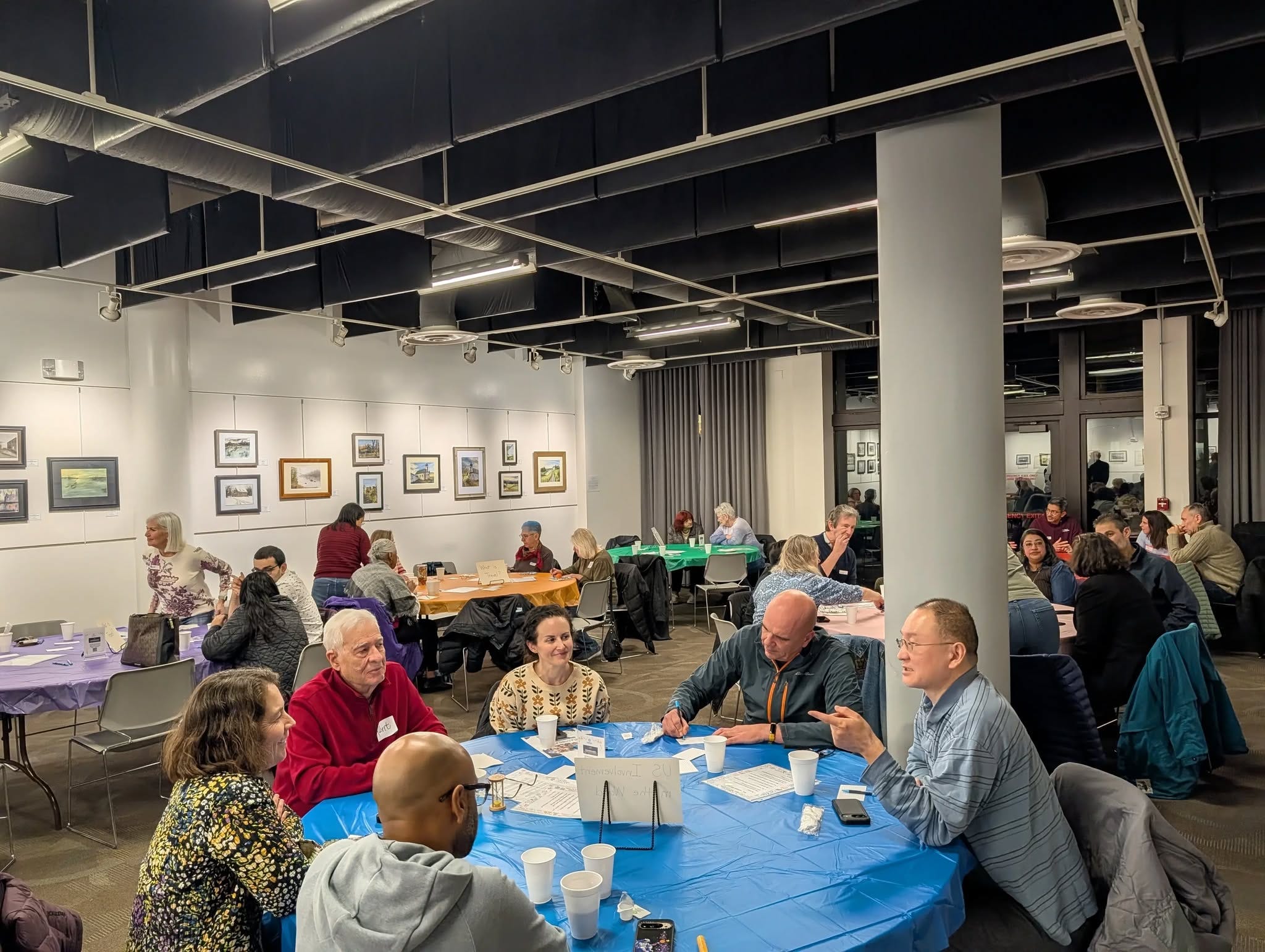
It’s that heart-glow that I hope you feel each time you step into a BreadBreakers gathering. I certainly felt it at our January dinner. I learned that night that this is a community that knows how to coffee-mingle! I’ve never seen the room buzz for so long after the clock struck 8:30.
I hope you’re ready to do it again this month, because as long as loneliness and division persist in this world, we’re going to need spaces of belonging and compassionate discourse. We have our BreadBreakers Game Night coming up on the 18th, and our next community dinner a week after on the 24th - looking forward to seeing you there. Don’t forget to invite a friend :)
Food for Thought - Where Are You Traveling This Week?
I wanted to begin this Food for Thought by sharing something that Albert, one of our volunteers and table hosts, wrote in his event description for the BreadBreakers small-group lunch this Saturday. This lunch - pulling on a thread many of you initially began at last month’s community gathering - is focused on a topic I find particularly moving: travel (....get it?....sorry....)
Travel is more than movement across geography, visiting cities, viewing landscapes and counting distances. Travel is also an inward movement: an encounter with difference that rearranges how we see the world and ourselves.
When we travel, we are exposed to other ways of organizing life: different assumptions about time and values, family and belonging, work and dignity, authority and trust, hospitality and faith. Even brief encounters can unsettle what we once considered “normal” or self-evident, sometimes gently, sometimes harshly, not too much differently as we may encounter on the other side of our divided country.
Some of us travel seeking beauty, rest, or novelty. Others travel to escape the noise, to understand, to remember, or simply to feel less confined by familiar routines. And when we return, we often carry more than we expected: stories, questions, discomforts, changed perceptions, or a renewed sense of home. The focus of our discussion is not destinations or expertise. It is about meaning. How encounters with different worldviews leave traces in us—and how those traces shape the way we interpret our own world once we return.
Each experience is partial, each perspective incomplete, and yet, together, we can see more of the whole. Shared at the table, such diversity becomes something lived rather than abstract.
This conversation shall prompt us to reflect on two simple questions: What do we look for when we travel to other places and cultures? And what do we bring back—beyond souvenirs and photographs?
I found myself grinning in appreciation when I read what Albert wrote. I was struck by the beauty and truth of it.
As I reflected on it more, I realized that travel - as Albert wrote of it, and as the Dining Room Team conceptualized it as a topic last month - is a form of what we do at BreadBreakers. It is the same essential act, just in a particularly mobile formulation, like a photon when it’s a wave instead of a particle.
Quantum physics aside (and I know that whether you’re a physicist or a person who hates physics, you’re glaring at me right now), what I mean is that during a trip and during a dinner, our objective is the same: to see something we couldn’t have seen otherwise. To know something we couldn’t have otherwise known. To see a piece of the world we could’ve never otherwise found.
I would’ve never known, before going to Ireland back in 2019, that the Irish call WWII “The Emergency.” That address numbers are optional (”at the bend” is perfectly acceptable; the post man knows, after all). That at one such address-less house outside Dublin there lives an extremely kind couple; she, a sort of Irish Mr. Rogers / Bob Ross hybrid with a TV show that teaches kids how to draw; he, a fellow of the sort who will drive his car behind yours to make sure you get to the local pub okay during one of Ireland’s biggest snowstorms in years. Both, the parents of a dozen kids who each call, one after another, to make sure the two of them are doing alright in said snowstorm. (”Oh yes, chicken, we’re just chatting with our AirBnB visitors!”)
On our trips and at our tables, we get new information; we also get new glimpses of humanity.
The thing is, there are things you have to learn firsthand. Literally or figuratively, you have to get up, put on your shoes, and go seek it out. You have to feel it with your hands, see it with your own eyes.
It’s what Jewish-American journalist Milton Mayer did in the early 1950s when he traveled to Germany and befriended ten former Nazis. He was trying to understand how Nazism had arisen in Germany, had attained and then retained power. Here’s what he found, as documented in his book, They Thought They Were Free:
“My faith found that of God in my ten Nazi friends. My newspaper training found that of something else in them, too. They were each a most marvelous mixture of good and bad impulses, their lives a marvelous mixture of good and bad acts. I liked them. I couldn’t help it. Again and again, as I sat or walked with one or another of my ten friends, I was overcome by the same sensation that had got in the way of my newspaper reporting in Chicago years before. I liked Al Capone. I liked the way he treated his mother. He treated her better than I treated mine.
[...]
Now I see a little better how Nazism overcame Germany - not by attack from without or by subversion from within, but with a whoop and a holler. It was what most Germans wanted - or, under pressure of combined reality and illusion, came to want. They wanted it; they got it; and they liked it.
I came back home a little afraid for my country, afraid of what it might want, and get, and like, under pressure of combined reality and illusion. I felt - and feel - that it was not German Man that I had met, but Man. He might be here, under certain conditions. He might, under certain conditions, be I.”
Travel can be as significant as flying to a former enemy country to speak with Nazis. Or it can be as simple as what an old family friend of mine did just this weekend, when she reached out to ask my perspective of some anti-ICE protests she’d seen online. She’s a conservative, and was stunned by some of the protestors’ calls to eliminate immigration laws and deportations altogether. She knew I often spoke with people of all sorts of beliefs at BreadBreakers, and wanted to know: what was she missing? Did other people really believe there should be no laws governing immigration at all? If so, why?
It opened a wonderful conversation, one that’s still ongoing, touching on the extent to which the “no immigration law” stance is common or not among ICE critics, what common ground many of us across the political right and left actually share on immigration, how ICE’s tactics played into the dynamics, and our shared empathy for the desperate desire so many have to come to America and share in our freedom and prosperity.
I’m positive we’ll both “return home” to our respective mental frameworks at the end. But we’ll both have a couple souvenirs we didn’t have before.
So, let me close, like Albert, with a pair of questions.
Where are you traveling this week?
And what are you going to bring back with you?
All the best,
Michael Graham
(P.S. Know someone who’d like to be on this email list? They can sign-up here!)
(P.P.S. If you wanna connect on Facebook, you can follow the BreadBreakers page and/or my page at these links!)